
Introduction
Large-scale infrastructure projects do sound exciting at first, don’t they? New highways stitching cities together, metro lines changing how people move, airports that look more like small towns than terminals. But if you’ve ever been part of one, you know the other side of the story. There are endless meetings, too many drawings, and a lot of people trying to pull in the same direction at once. And the scary part? Miss one small detail early on, and before you know it, timelines slip and budgets start creaking. One small clash can stall an entire site.
That’s why BIM modeling services have become such a big part of modern infrastructure delivery. Not as a buzzword, but as a practical way to bring order to complexity.
In this blog, you’ll learn how BIM modeling services support infrastructure projects, where they add the most value, and why so many project teams now treat BIM as the backbone of large-scale development.
What Are BIM Modeling Services in Infrastructure Projects?
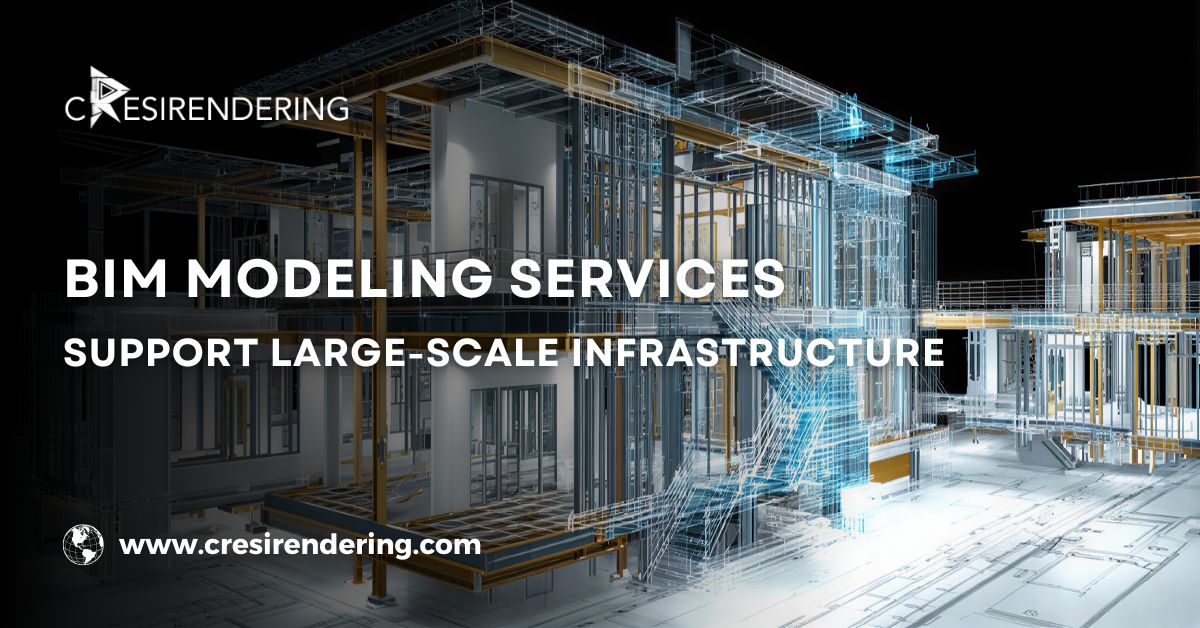
At its core, BIM modeling services involve creating intelligent 3D digital models that combine geometry with data. Not just how something looks, but what it’s made of, how it’s built, and how it’s maintained.
In infrastructure, this usually covers:
- Highways and bridges
- Railways and metro systems
- Airports and seaports
- Tunnels, drainage, and utility networks
Using tools like Revit 3D Modeling and other BIM platforms, teams develop coordinated models where every element carries useful information.
What makes this powerful for BIM for infrastructure is scale. Infrastructure projects stretch across long distances, involve layered systems, and run for years. BIM brings all that into one connected digital environment.
Instead of hundreds of disconnected drawings, you get a living model everyone can rely on.
Key Challenges in Large-Scale Infrastructure Projects
Before talking about solutions, it helps to be honest about the problems. Because big infrastructure jobs come with big challenges.
Multi-disciplinary Collaboration issues
Civil, structural, MEP, traffic, environmental. Each team has its own drawings and priorities. Keeping everyone coordinated is easier said than done.
Design conflicts and constructability risks
A pipe crossing a beam. A cable tray clashing with a girder. On paper, these are easy to miss. On site, they’re costly.
Tight schedules and budget overruns
Phased construction, traffic diversions, limited work windows. One delay can push everything off track.
Data management across long project lifecycles
Infrastructure assets last decades. But drawings get outdated, files go missing, and project knowledge fades as teams change. You know what? Most project teams don’t struggle because they lack skill. They struggle because the system itself gets messy.
How BIM Modeling Services Solve Infrastructure Challenges
This is where infrastructure BIM modeling starts earning its keep.
Improved Multi-Discipline Coordination
BIM brings architectural, structural, and MEP BIM Modeling Services into one shared model. Instead of working in silos, teams collaborate inside a centralized BIM environment. Everyone sees the same data. Updates are visible. Confusion drops.
It’s like moving from scattered WhatsApp chats to one clear group conversation. Less noise. More clarity. This is also where 3D BIM Modeling Services add real value, giving stakeholders a clear visual of how systems fit together.
Clash Detection and Risk Reduction
Clash detection is one of those features that sounds simple, but saves serious pain. BIM tools automatically check for conflicts between elements:
Ducts vs beams
Pipes vs foundations
Cables vs walls
Finding these during design process mean:
Less rework on site
Fewer change orders
Safer construction
Honestly, catching problems on a screen is far better than discovering them with a jackhammer.
Accurate Quantity Takeoffs and Cost Control
From a BIM model, teams can extract quantities directly. Concrete volumes, steel weights, cable lengths, you name it. This supports:
More reliable BOQs
Faster updates when designs change
Better budgeting decisions
For large-scale infrastructure projects, where quantities are massive, even small errors can mean big money. BIM helps keep that in check.
Construction Sequencing with 4D BIM
Here’s where schedules stop feeling abstract. 4D BIM links time with the 3D model. You don’t just see tasks on a chart. You watch the project get built, phase by phase. This helps teams:
Visualize construction sequences
Plan traffic diversions and access
Coordinate trades more smoothly
For long highways or metro corridors, that kind of planning makes a real difference.
5D BIM for Cost and Resource Management
Add cost data to the model, and you get 5D BIM services. Now, when a design changes, the cost impact updates too. Almost instantly. Project managers can:
Track budgets in real time
Compare scenarios
Make faster, informed decisions
It’s not about perfection. It’s about control in a project where surprises are common.
BIM Modeling Services Across Infrastructure Project Types
Different projects, different needs. But the same BIM backbone supports them all.
Roads, Highways, and Bridges
BIM supports:
- Accurate alignments and profiles
- Structural detailing for decks and piers
- Coordination with drainage and utilities
Everything fits together digitally before construction begins.
Railways, Metro, and Transit Systems
From track layouts to stations and depots, BIM helps coordinate:
- Civil works with structures
- Platforms with MEP systems
- Emergency routes with safety requirements
For transit projects, clarity equals safety.
Airports and Seaports
These facilities are complex ecosystems. Large spans, dense MEP networks, security systems everywhere. BIM helps manage spatial planning so nothing turns into a tangled mess above ceilings.
Utilities and Smart Infrastructure
Underground utilities are easy to forget. Until they clash. BIM models water, sewer, power, and telecom networks clearly, reducing risks and supporting integration with smart city systems.
And when paired with Scan to BIM Services, even existing utilities can be captured accurately for upgrades or expansions.
Long-Term Benefits of BIM Modeling Services
Here’s the thing. BIM isn’t just about design and construction. After handover, the model becomes a valuable asset:
- Equipment data
- Asset locations
- Maintenance schedules
Facility teams can use it for operations, upgrades, and future planning. Over time, many infrastructure owners use BIM as the base for digital twins, connecting real-world data with the model. So yes, BIM keeps paying off long after the ribbon-cutting.
Why Choose Professional BIM Modeling Services?
Big projects need more than software. They need experience. Professional BIM modeling services bring:
- Expertise in infrastructure workflows
- Knowledge of global BIM standards
- Teams that can scale with project demands
For long, complex projects, that structured support reduces risks and keeps things moving. It’s like having a seasoned guide on a long trek. You could go alone, but why would you?
Conclusion
BIM modeling services have quietly become the backbone of how modern infrastructure gets delivered, bringing clarity to projects that would otherwise feel overwhelming. From coordinating multiple disciplines and catching design conflicts early to managing quantities, schedules with 4D BIM, and costs through 5D BIM services, BIM helps teams stay in control when scale and complexity are at their highest.
Beyond construction, these intelligent models continue to add value by supporting asset management, maintenance, and future upgrades, making them just as useful years after handover.
As cities expand and infrastructure demands grow, BIM for infrastructure isn’t just a smarter way to build, it is becoming the natural way forward for anyone serious about delivering reliable, efficient, and future-ready large-scale projects.
